
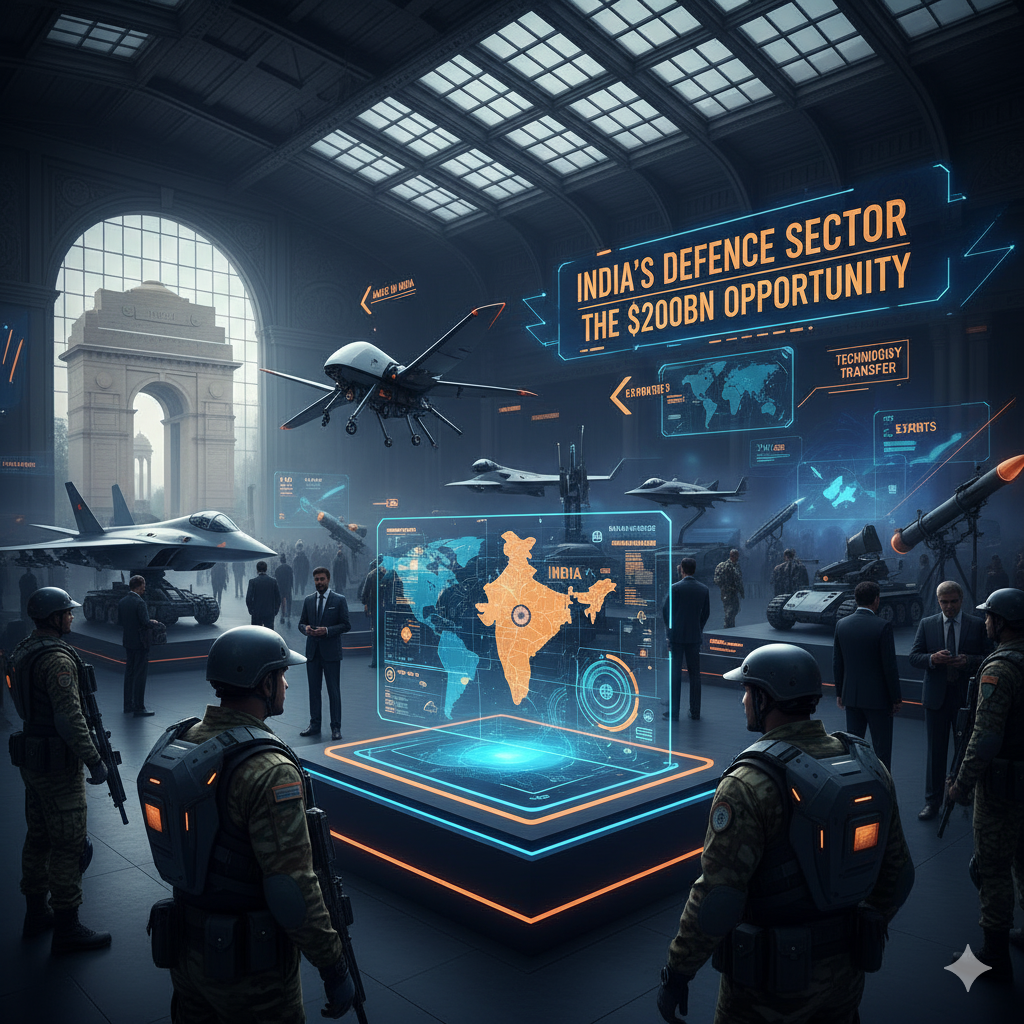
India’s defence sector is on the cusp of a major transformation. Once heavily dependent on imports, the country is now racing toward self-reliance in defence manufacturing under the Atmanirbhar Bharat initiative.
With an estimated $200 billion opportunity in the coming decade, India aims to become not just a major consumer but a global exporter of advanced defence technologies — from aircraft and drones to precision weapons and AI-driven warfare systems.
This evolution is not only vital for national security but also promises massive industrial growth, employment, and technological innovation.
Understanding the $200 Billion Opportunity
The Scale of Global Defence Spending
The global defence market is valued at over USD 200 billion annually, and India — currently one of the world’s largest defence importers — is positioned to claim a significant share of this value chain.
In FY 2024–25, India achieved record-high defence production of over ₹1.5 lakh crore (≈ USD 18 billion), marking an 18% year-on-year increase.
The government’s push toward indigenization, combined with FDI liberalization and private participation, could catapult the sector’s growth toward the $200 billion mark in the next decade.
Key Drivers Behind India’s Defence Boom
1. Rising Security Demands
India’s complex geopolitical environment — from border tensions to maritime challenges — necessitates constant modernization of armed forces. The need for advanced, self-sufficient systems drives huge domestic demand.
2. Government Policy Reforms
The government’s Atmanirbhar Bharat and Make in India policies emphasize indigenous defence production.
Key measures include:
-
FDI up to 74% under the automatic route
-
Dedicated Defence Corridors (Uttar Pradesh & Tamil Nadu)
-
Funding under the “Make” and “iDEX” schemes for defence startups
-
De-licensing of many defence products
3. Private Sector Participation
The entry of private giants and startups has transformed India’s defence ecosystem.
Examples include:
-
Adani Defence investing over ₹3,000 crore in ammunition and missile facilities.
-
JSW Defence developing mobility vehicles for the Indian Army.
-
Reliance Defence & Diehl (Germany) collaborating on ₹10,000 crore precision ammunition production.
4. Export Potential
India currently exports defence equipment to 85+ countries, with FY 2023 exports exceeding USD 2 billion.
As India enhances capabilities and certification standards, exports could grow 5x by 2030.
5. Technological Advancement
Emerging areas like AI, drones, radar systems, quantum computing, and cyber warfare are witnessing rapid innovation — creating space for startups, MSMEs, and research institutions to thrive.
Challenges on the Path to $200 Bn
Despite the potential, a few structural hurdles persist:
-
Technology Gaps: India still relies on imports for propulsion systems, sensors, and high-end electronics.
-
Long Procurement Cycles: Defence contracts often face delays and bureaucratic red tape.
-
Funding Constraints: Startups and MSMEs need better access to defence-specific financing and credit lines.
-
Global Compliance: Export norms (like ITAR) and international restrictions can limit partnerships.
Addressing these challenges will determine how quickly India can unlock the full $200 billion potential.
Conclusion
India’s defence sector is no longer defined by imports — it’s driven by innovation, manufacturing, and exports.
The journey from buyer to builder is underway, and the $200 billion opportunity is within reach.
With bold policy reforms, private participation, and growing technological depth, India has the potential to become one of the world’s top five defence producers and exporters by 2035.